What we believe
The kanbanwall way
How we think a project should be run with Kanban, in five beliefs.
1A good Kanban board gets more work finished
Watching cycle time alone makes you aware of how long work really takes, and that is enough to get more of it finished. Setting the right limits does the rest.
2Most teams have a Kanban board. Few do Kanban
Without watching cycle time and without limits, a Kanban board is a wall with cards on it.
Much of that is the tools' fault. Most of them never show cycle time, and the statistics they do show are so complex that hardly anybody understands them.
3Watch a few simple numbers
How many tasks you finish every two weeks, say, and with what cycle time. That is all it takes.
4Get the whole team involved
Most people on a team never look at the Kanban board in Jira. They change the status on the task itself — open, closed, whatever it is — and never see the board. That defeats the whole point of Kanban: everybody needs to see what is stuck and what is taking too long, and jump in to help.
We believe a colorful, fun board full of icons gets people engaged. When you write your own card, give it a color and an icon, and put a hat on yourself or a colleague, you come back to look at it. And while you are there, you see how the project is going and what is late, and you act.
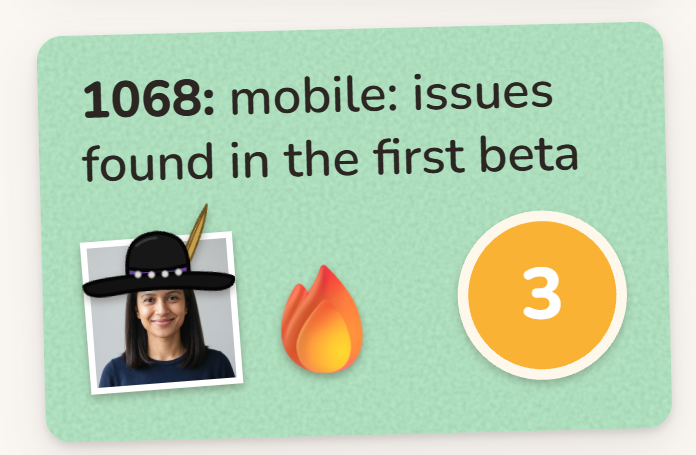
That is also why there is no "filter by person" here. Kanban is a team sport: the work belongs to everybody on the board.
5The board is the information radiator
Kanban theory says the board should radiate information to the whole team. When the team really looks at it — gamified a little, fun to come back to — it does.
And because the wall is flexible, what matters can live right where the work is coordinated: a screenshot of the roadmap, a note about something key to remember, the goal of the week.
Want the theory behind all this — why limits unlock work, and why watching cycle time pays off? Read why Kanban works. Already have a wall? Tips & tricks has six things worth knowing. Or put your own hat on a card:
Try a wall →